
Beanies are the lowest cost way to put a logo on a team for an entire winter. One size fits nearly everyone, the price point works for large groups, and a knit cap sits at eye level on every commute, jobsite, and school pickup from November through March.
The category has more range than it gets credit for. Cuff style, knit gauge, fiber, lining, and decoration method all change how a beanie looks, how warm it runs, and how cleanly it holds a logo. Choosing well is the difference between a cap people grab every morning and one that ends up in a junk drawer.
Here is how to choose custom beanies for a company, crew, or gift program, and what each decision changes in the finished product.
Why Are Beanies a Strong Choice for Company Apparel?
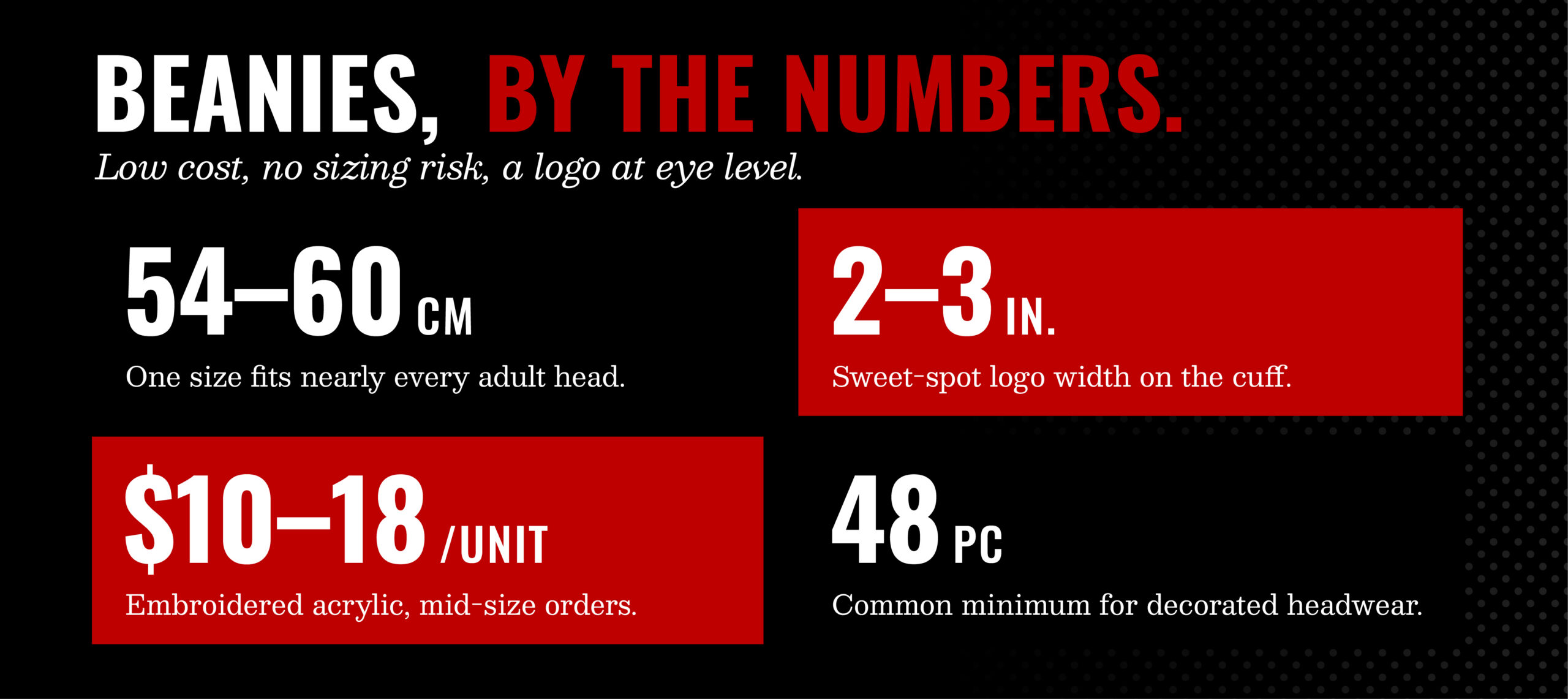
Beanies deliver high visibility at a low unit cost with almost no sizing risk. A stretch knit cap fits roughly a 54 to 60 centimeter head circumference, which covers most adults and eliminates the size collection step that slows down every other apparel order.
Placement drives the visibility. A logo on a beanie sits on the front of the head, in the line of sight of everyone the wearer faces. Headwear consistently ranks among the most visible promotional categories for that reason.
Beanies also anchor a year round hat strategy. Structured caps and truckers carry a brand through spring and summer, and beanies take over when the temperature drops. We covered the warm weather side of that ladder in our breakdown of custom hat trends for 2026.
Cuffed or Uncuffed: Which Beanie Style Works Best for a Logo?
Cuffed beanies are the better choice for most company programs. The folded cuff creates a flat, double layered panel that holds embroidery or a patch cleanly, and the extra layer over the ears adds warmth where people need it most.
Uncuffed beanies have a slimmer profile. They sit closer to the head and fit under hard hats and helmets, which makes them useful for crews who wear head protection. The tradeoff is a single layer of knit for decoration, which works best with a patch or a small, simple embroidered mark.
Slouch and fisherman styles round out the category. Slouch beanies read casual and streetwear, which suits lifestyle brands and younger audiences. Fisherman beanies sit shallow above the ears for a fashion look, with a shorter cuff that limits logo height.
For a mixed team where nobody wants to think about fit, a cuffed ribbed acrylic beanie in a dark neutral is the safest default.
What Beanie Material Should You Choose?
Acrylic is the default for company beanies. It holds color, survives machine washing, stays soft, and keeps the per unit cost low enough for large orders. Acrylic also gives embroidery a stable surface, so stitched logos stay crisp through repeated washing.
Wool and wool blends run warmer and read more premium, which suits client gifts and outdoor programs where warmth matters. Wool carries a higher price and needs gentler care.
Fleece lined beanies add a second layer inside the cap for real cold. They are the practical choice for crews working outside through January and February, and the lining also improves comfort against the forehead.
Recycled polyester and recycled acrylic yarns have become a common option for companies with sustainability goals. They perform close to standard acrylic and let a program align its apparel with its environmental commitments.
Should You Embroider a Beanie or Use a Patch?
Direct embroidery works best on fine to medium knit beanies with a clean, simple logo. The stitches sit on the cuff, survive washing, and produce a durable, professional finish. For legibility, embroidered text should stay at least a quarter inch tall.
Size limits apply. A common guideline from decorators puts the maximum embroidery area on a beanie cuff at roughly 4.2 inches wide by 2.1 inches tall, which keeps the design crisp without stretching the knit. Most cuff logos land between 2 and 3 inches wide.
Patches are the better choice on chunky or cable knits. On a loose, textured knit, embroidery stitches sink between the loops and detail gets lost. A woven, embroidered, leather, or PVC patch sits on top of the knit and keeps fine detail intact.
Leather and faux leather patches have become the premium look across headwear, and they translate well to beanies. A laser engraved patch on a cuffed knit reads as a retail product, which makes it a strong option for client gifts and merch programs.
Which Beanies Work Best for Outdoor Crews?
Outdoor crews need warmth first, which points to cuffed, fleece lined, or heavy gauge acrylic beanies. For crews, the cuff earns its place because the doubled knit covers the ears through long shifts outside.
Visibility matters on active jobsites. Hi vis orange and safety green beanies add a layer of visibility above the collar, and they decorate cleanly with dark thread or a contrasting patch.
Hard hat compatibility narrows the options. A thin, uncuffed knit or a dedicated hard hat liner fits under head protection, while a thick cuffed beanie does not. Many crews keep both: a liner for the job and a cuffed beanie for the commute and breaks.
Durable headwear is part of a broader shift toward workwear crews want to wear off the clock, which we covered in our look at custom workwear trends. For outdoor crews working exposed sites, such as teams ordering custom workwear in Bellefontaine near the highest ground in Ohio, a warm, durable beanie gets worn every day of the season.
Do Custom Beanies Get Worn Beyond Winter?
Beanies get worn well past the cold months. Lighter knit and slouch styles appear in fall and spring, and in cooler climates a fine gauge beanie stays in rotation from October into April.
That extended season lifts the value of each cap. A beanie worn through 5 or 6 months generates far more impressions than a seasonal item worn for a few weeks, which keeps the cost per impression low even on premium versions.
Gifting extends the life further. Beanies rank among the most common add ons in holiday gift sets, pairing with a hoodie or quarter zip, because they cost little, fit everyone, and get worn immediately.
How Much Do Custom Beanies Cost?
Custom beanies are among the most affordable decorated apparel items. Standard acrylic beanies with direct embroidery typically run $10 to $18 per unit in mid size orders, depending on stitch count and quantity.
Upgrades add cost in predictable steps. Fleece lining, pom poms, wool blends, and premium brand blanks like Carhartt each raise the base price. Leather or PVC patches typically add a few dollars per unit over direct embroidery, along with a one time setup for the patch.
Per unit pricing drops as quantity rises, since digitizing and patch setup are fixed costs spread across the order. For new customers, a 48 piece minimum is common for decorated headwear, with the best per unit pricing arriving at higher quantities.
What Should You Prioritize When Ordering Custom Beanies?
Start with the wearer's conditions. Crews working outside need a cuffed, lined, or heavy gauge knit, plus a liner option for hard hats. Office teams and gift recipients can lean toward finer knits, wool blends, and premium patches.
Match decoration to the knit. Embroider fine and medium knits with simple logos, and use patches on chunky or textured knits. Keep logos between 2 and 3 inches wide on the cuff, and keep text above a quarter inch tall.
Order ahead of the cold. Beanie demand peaks from November through January, so placing orders in October or November gets caps on heads before the first hard freeze.